
Home / Free guides / How to pack a storage container
How to pack a storage container
A bit of time spent packing well saves you a lot of time, and a few broken things, later. Here is what to get before you start, how to pack each kind of item, and how to load the container so you can find everything again.
Get your supplies first
Gather everything before you pack the first box, so you don’t run out halfway.
- Strong boxes in a few sizes: big ones for light things, small ones for books and heavy things
- Good packing tape, and a tape gun. It is worth every cent
- Two or three thick permanent markers
- Bubble wrap or packing paper for anything fragile
- Cloth furniture covers or old sheets. Not plastic, which traps moisture
- Rope or straps for bed slats, garden tools and odd shapes
- Small zip-lock bags for screws and bolts
- Clean, dry pallets for the container floor
- A few moisture absorbers
- A good outdoor padlock that fits our lockbox (which padlock to buy)
Where to get them
We don’t sell boxes or hire out trailers. It is one of the ways we keep our prices low.
New boxes from a packaging supplier are the strongest, and you can keep them for next time. People often give away used moving boxes online for free. Use only boxes that are clean, dry and not torn.
Towels, blankets, doonas and pillows make good padding, and they have to move anyway.
For fridges and washing machines, you can hire a stair trolley from most hardware stores for a few hours. It saves your back.
Packing boxes the right way
01
Label, label, label
Write what is inside, and which room it came from, on the top and on two sides. You will often only see one side once it is stacked.
02
Keep a list
Write down what goes in each box as you pack, and take a few photos. It helps you find things, and it helps with any insurance claim.
03
Heavy at the bottom
If a box has mixed weights, put the heavy things at the bottom and mark it “this way up”.
04
Don’t overload
Keep each box to around 20kg, or what you can lift without straining. Books go in small boxes.
05
Fill the gaps
Fill empty space with packing paper so nothing moves, and tape the tops flat so the boxes stack squarely.
06
No rubbish bags
Rubbish bags rip, squash and trap moisture, which leads to mildew. Use boxes, tubs or wardrobe cartons.
Item by item
Everything you store must go in clean and completely dry. Damp things bring moisture into the container, and that is how mould starts.
Furniture
Take bed frames and tables apart. Put the screws and bolts in a zip-lock bag and tape it to the piece they belong to. Tie bed slats together. Cover sofas, chairs and anything of value with cloth covers or sheets. Stack chairs seat to seat with a cloth between them. Never sit furniture straight on the container floor: put it on pallets. Use the space inside wardrobes and drawers for linen and light things.
Mattresses
Cover them with a mattress bag or sheet and stand them on their end along a wall. It saves floor space and keeps them in shape.
Fragile things and glassware
Wrap each piece on its own in packing paper or bubble wrap. Put crumpled paper in the bottom and top of the box, pack plates on their edge, and fill every gap. Use strong boxes, mark them “FRAGILE” on every side, and never stack anything heavy on top.
Fridges, freezers and washing machines
Defrost, clean and dry them completely, and drain the water from washing machines and dishwashers. Wedge fridge and freezer doors open so air can move, and use the space inside for light things like linen. Follow the maker’s storage instructions for large appliances.
TVs, computers and electronics
Clean and dry them first. The original boxes are best; if you don’t have them, use strong cartons and moving blankets. Tape cables to the item they belong to, or bag and label them. Take out any lithium-ion batteries, which can’t be stored, and keep them at home. Sensitive electronics may be better somewhere climate controlled.
Clothes, linen and books
Wash and dry everything first. Hanging clothes travel best in wardrobe cartons. Use sealed boxes or tubs, not bags. Pack books flat or on their spines in small boxes, so they stay light enough to lift.
Tools and anything metal
Wipe metal tools with a few drops of oil to keep rust off, and keep them away from fabric and furniture that could be stained. Take the batteries out of cordless tools: lithium-ion batteries can’t be stored.
Mowers and garden gear
Drain the fuel from mowers, whipper snippers, blowers and other petrol gear, because fuel can’t be stored. Clean off the dirt and grass. Stand shovels, rakes and hoes together in an empty bin so they don’t fall over. Put a drip tray under anything that might leak oil.
A car or motorbike
Cars and bikes need their own preparation, from the battery to the tyres. See our car storage page for the full list.
Loading the container
1
Pallets down first
Lay clean, dry pallets close together across the floor, leaving a small gap from the walls. Air can move underneath, and your things stay off the floor.
2
Back to front
Things you rarely need go in first, at the back: seasonal gear, spare furniture, archive boxes. Things you use most go in last, near the doors.
3
Stack high and steady
Our containers are 2.39m high inside, so use the height. Heaviest at the bottom, lightest on top, boxes stacked squarely. Freestanding shelving works well, as long as it isn’t fixed to the container.
4
Leave room for air
Keep a small gap between your things and the walls, and don’t pack hard against the roof. Keep heat-sensitive things away from the roof and outer walls.
5
Keep a path
If you can, leave a narrow walkway down the middle or along one side, so you can reach the back without unloading everything.
6
Map it and lock it
Draw a simple map of what is where, stick it on the wall, and keep a copy at home. Then lock up with your padlock in the lockbox.
Nothing can be stored or left outside your container, even for a short time. Why not?
What can’t go in
- Fuel, gas bottles, paint thinners, chemicals and anything flammable
- Lithium-ion batteries, or anything with one inside
- Food, plants, pets or anything perishable or living
- Documents with personal information, like customer files, staff records or medical records
- Anything illegal, stolen or hazardous
Before you lock up
Goods worth more than $1,000 in total, or anything irreplaceable, can only be stored if they are itemised and specifically insured. Insurance is up to you, so sort it out before you move in.
Packing questions
- How should I lay out my container so I can easily reach what I need?
- How should I pack my container to reduce condensation?
- Should I put pallets on the floor before I load my goods?
- Should I use moisture absorbers in my container?
- Can I install shelving or racking inside my container?
- What should I do on my move-in day?
More free guides
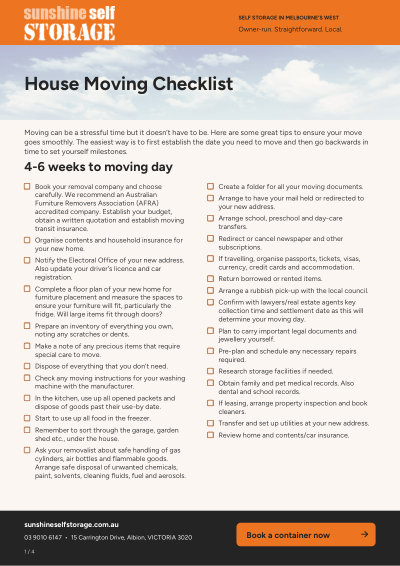 House Moving Checklist
Everything to do, week by week, from booking movers to the keys. Tick it off as you go.
Read online or download
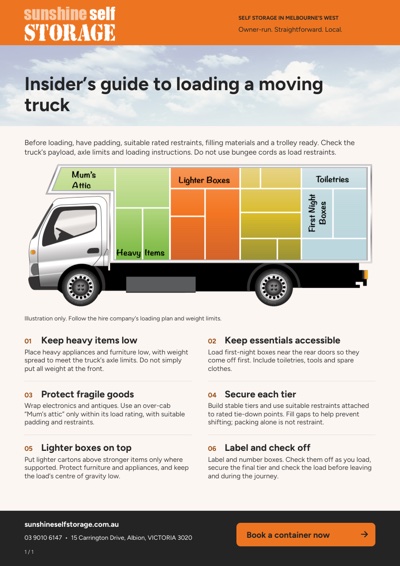 Insider's Guide to Loading a Moving Truck
Heavy things low, essentials near the doors, every tier secured.
Read online or download
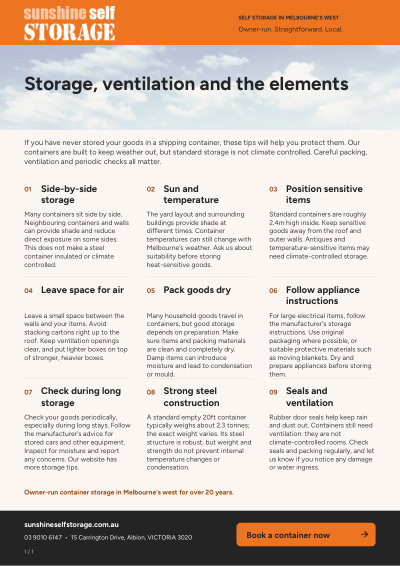 Storage, Ventilation and the Elements
How to pack dry and leave air space so your things come out as they went in.
Read online or download
Ready to store with us?
Book online in about two minutes. No deposit and no setup fee.