
Home / Free guides / Shipping container facts
Shipping container facts
Shipping containers are strong, practical structures built to carry goods around the world. Here are 23 facts about how they are built, where they came from, and what they can and can't handle.
Free PDF (8 pages, 7.7 MB). No email needed.
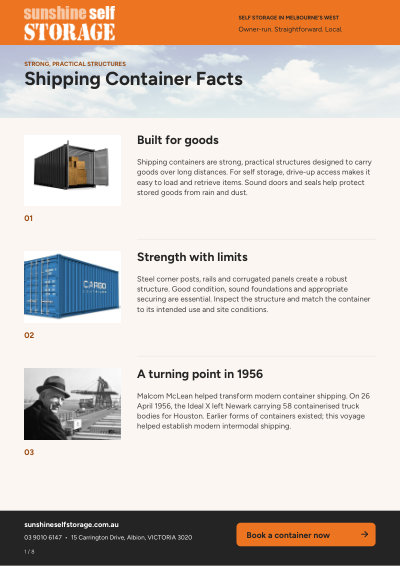
Strong, practical structures
01
Built for goods
Shipping containers are strong, practical structures designed to carry goods over long distances. For self storage, drive-up access makes it easy to load and retrieve items, and sound doors and seals help protect stored goods from rain and dust.
02
Strength with limits
Steel corner posts, rails and corrugated panels make a robust structure. Good condition, sound foundations and proper securing are essential. Inspect the structure and match the container to its use and site.
03
A turning point in 1956
Malcom McLean helped transform modern container shipping. On 26 April 1956, the Ideal X left Newark carrying 58 containerised truck bodies for Houston. Earlier forms of containers existed, but this voyage helped establish modern intermodal shipping.
How the network works
04
Replacing break-bulk cargo
Before containers, much general cargo was handled piece by piece as break-bulk cargo. Standard containers cut the repeated handling as goods moved between trucks, trains and ships, saving time and handling costs.
05
A worldwide container network
Containers circulate through a worldwide network of ports, ships, railways and roads. Fleet size and transport movements are different measures: a container can make many journeys, so a trip count isn't the number of boxes in existence.
06
Millions of boxes in circulation
The global fleet includes containers at sea, on land, in depots and with customers. BIC's BoxTech database alone holds technical data for over 15 million containers. It's a registry, not a complete count of the world fleet.
Containers on the move
07
Not every box is moving
Some containers are in transit, while others are being loaded, unloaded, repaired or waiting for their next trip. How many are in use changes with trade, demand, maintenance and transport links.
08
Over 280 million transported
The World Shipping Council reports that over 280 million containers were transported in 2025. These are transport movements, not unique containers. Major trade routes link Asia, Europe, the Americas and many other regions.
09
A global scale
Shipping containers connect businesses and households across continents. Standard 20ft and 40ft sizes mean the same box can move between ship, train and truck, supporting a vast network of everyday trade.
Manufacturing and marine risks
10
Container manufacturing
China is a major centre of shipping-container manufacturing, with established steelworking, production and export networks. Large factories supply the global fleet with standard dry containers, refrigerated containers and specialist equipment.
11
Containers can be lost at sea
The World Shipping Council estimates 1,478 containers were lost at sea in 2025, out of over 280 million transported. Losses vary each year. Extreme weather and fire remain leading causes, and every loss can have safety and environmental consequences.
12
Lost containers are hazardous
A container overboard may float for a while or sink, depending on its condition and contents. Floating or partly submerged containers can be hard to see, are a risk to small vessels and can cause pollution.
New uses and bigger ships
13
Retirement and reuse
Containers eventually leave transport service. Some are resold for storage or other uses; some are repaired, recycled or scrapped. Reuse can extend a container's useful life, as long as its condition is checked.
14
Beyond shipping
Containers can be turned into offices, sheds, shops and homes. Modifying one for people to use needs proper design, engineering and approvals. Cutting walls or adding openings can change how the structure performs.
15
Larger container ships
Shipping lines keep investing in larger, more efficient vessels. Modern ultra-large container ships can carry around 24,000 TEU or more. TEU means twenty-foot equivalent unit: a 40ft container counts as two TEU.
Trade on a global scale
16
Capacity has grown
Container ships have grown dramatically since the early years of containerisation. Today's ultra-large vessels carry many times the capacity of the first purpose-built ships. Capacity is usually quoted in TEU, not individual boxes.
17
Over 80% travels by sea
UN Trade and Development reports that over 80% of international merchandise trade by volume moves by sea, including container and bulk cargo. Road and rail connect ports to suppliers and customers inland.
18
Shanghai's huge throughput
Shanghai handled 55.06 million TEU in 2025, according to Shanghai International Port Group. Port throughput counts handling activity in twenty-foot equivalents, not unique containers, and shows the extraordinary scale of modern ports.
Storage space and structure
19
What fits in a 20ft container?
Our standard 20ft container has 33.1 cubic metres of space inside. How many shoe boxes or other items it holds depends on their size, packaging, stacking and the access space you leave, so measure first rather than relying on a fixed count.
20
A long useful life
A well-maintained container can stay useful long after its shipping service. Lifespan depends on corrosion, damage, repairs and exposure. Regular checks of the roof, doors, seals and structure keep it suitable for storage.
21
How the structure works
Corner posts and fittings carry stacking loads, while rails, walls, ends and doors all add strength. For transport use, the container's safety approval plate and inspection status matter. Alterations or damage can reduce strength.
Weather, stacking and your storage
22
Weather resistance needs context
Steel gives containers useful weather resistance, but there is no universal safe wind-speed rating for an unsecured container. Wind performance depends on condition, anchoring, foundations, exposure and site design. Don't assume a container is cyclone-proof.
23
Stacking needs engineering
Containers are designed to be stacked under specified conditions. A safe height depends on the container's rating, loads, condition, foundations and securing system. Check the safety approval plate and get professional advice.
Ready to store with us?
We hope you've enjoyed learning more about the humble shipping container. Choose a drive-up 10ft, 20ft or 40ft container in Albion. Access to the yard is available from 5am until 9pm, 7 days a week, 365 days a year.
Sources
Statistics checked October 2026.
- World Shipping Council: containers lost at sea and transport volumes
- UN Trade and Development (UNCTAD): share of trade carried by sea
- Shanghai International Port Group: 2025 throughput
- BIC BoxTech: container database
- Smithsonian: the history of modern container shipping
- International Maritime Organization: safe container design, testing and stacking
More free guides
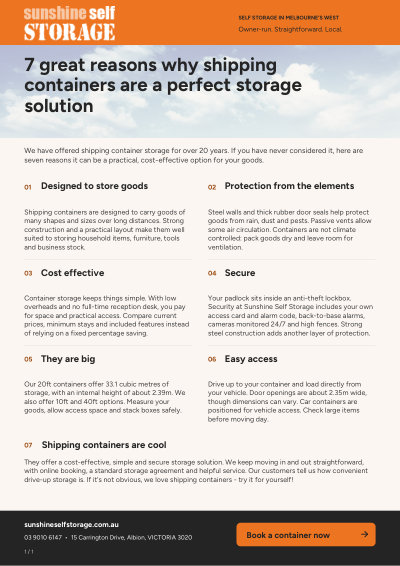 7 Great Reasons Why Shipping Containers Are a Perfect Storage Solution
Why a container is a strong, simple way to store.
Read online or download
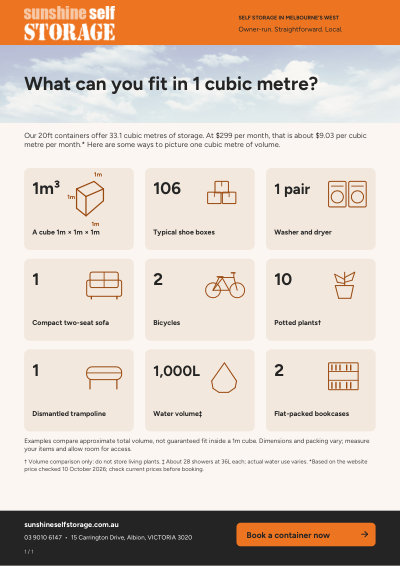 What Can You Fit in 1 Cubic Metre?
A picture guide to how much space your things really take.
Read online or download
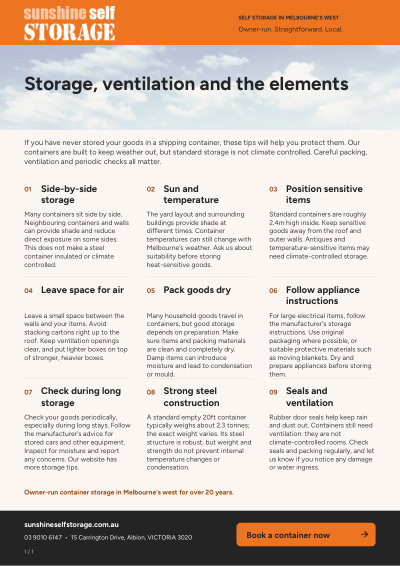 Storage, Ventilation and the Elements
How to pack dry and leave air space so your things come out as they went in.
Read online or download
Ready to store with us?
Book online in about two minutes. No deposit and no setup fee.